DATASET 05 · Psycholinguistics
Eye-Tracking Reading and Cognition Corpus
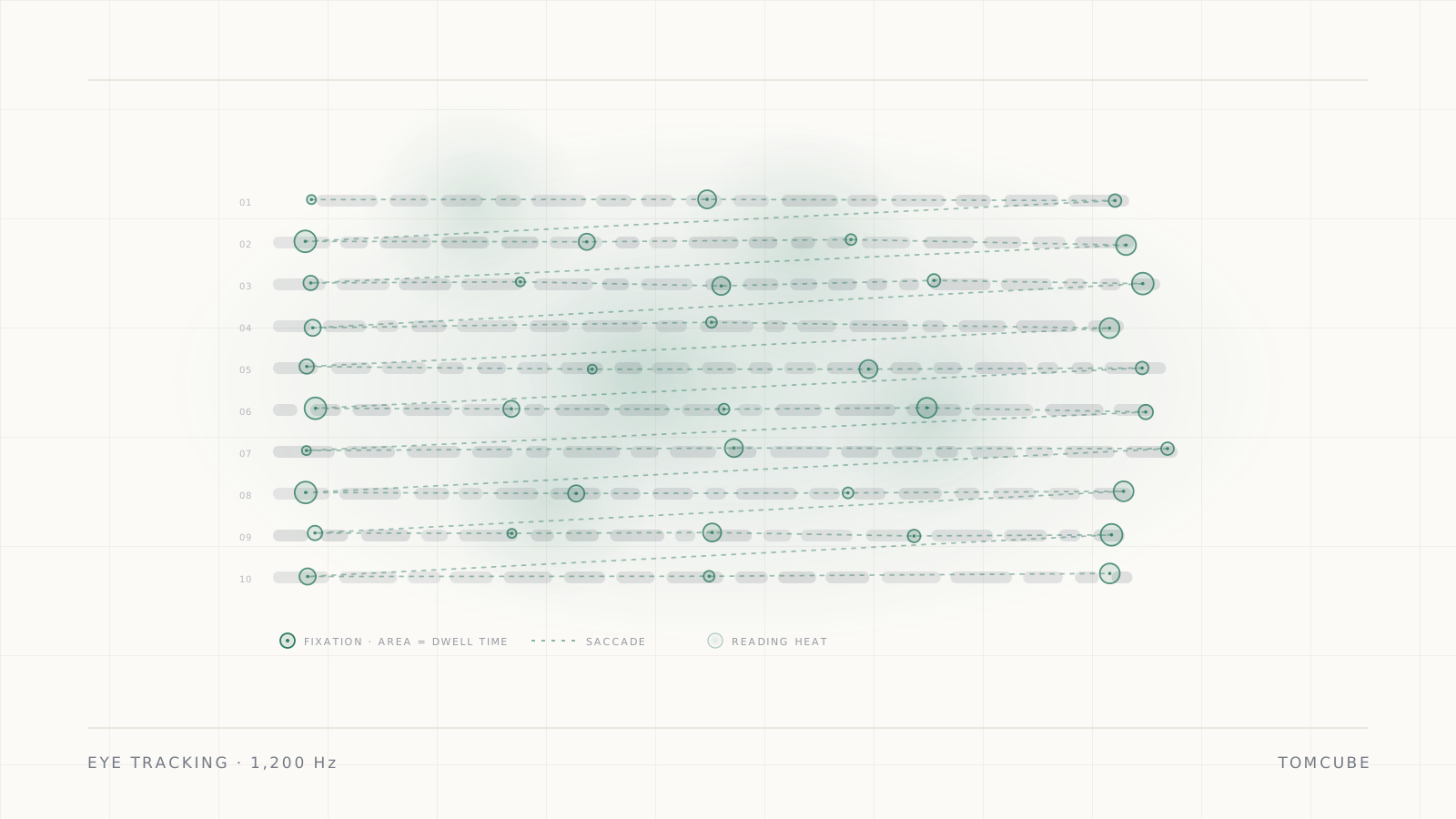
Reading eye movements from 960 participants over 1,280 Chinese texts, with areas of interest, fixation measures and aligned read-aloud speech.
- Scale
- 420 hours
- Participants
- 960 participants
- Languages
- Modern written Chinese (4 genres)
- Annotation
- Fixation and saccade events, Area-of-interest segmentation, Fixation duration measures, Read-aloud speech alignment
- Formats
- CSV / TSV / WAV / JSON
- Sync
- Eye-tracking and speech sync error ≤ 3 ms
- License
- Research license / Commercial license
- Updated
- May 22, 2026
01 / Composition
Scale, key metrics and data streams
Reconstructing reading cognition from millisecond fixation traces
- 420 h
- Total duration
- 960
- Participants
- 1,280
- Texts
- 1,000 Hz
- Sampling rate
| Stream | Specification | Notes |
|---|---|---|
| Eye tracking | 1,000 Hz · binocular | Screen-based remote tracker, including pupil diameter |
| Audio | 48 kHz / 24-bit | Synchronized speech from the read-aloud condition |
| Text | UTF-8 / JSON | Word boundaries, syntax trees and area-of-interest definitions |
The table lists capture parameters for a sample batch; final specifications follow the documentation delivered with the data.
02 / Dataset notes
Collection, annotation and quality control
The notes below explain how the data was collected, annotated and verified, and can be used as a basis for methodological citation and proposal assessment.
Overview
The Eye-Tracking Reading and Cognition Corpus contains eye-movement records from 960 participants reading 1,280 Chinese texts, totaling 420 hours recorded between May 2024 and March 2026. The texts cover four genres — expository, argumentative, narrative and news — with an average length of 620 characters; word familiarity and syntactic complexity are graded and controlled.
Participants are stratified by reading proficiency (skilled readers, average readers, second-language learners), age and educational background. The experiment has both silent-reading and read-aloud conditions; the read-aloud condition also records speech, enabling research on eye-voice span and reading fluency.
Collection protocol
The experiment runs in a light-controlled behavioural laboratory. A screen-based remote eye tracker samples at 1,000 Hz and records binocular fixations and pupil diameter. The participant’s head is stabilized by a chin rest, with the eyes 65 cm from the screen; if five-point calibration error exceeds 0.5° of visual angle, calibration is repeated. A fixation cross appears before each text, and comprehension questions follow; trials with accuracy below 70% are marked invalid.
The read-aloud condition uses a headset microphone recorded at 48 kHz / 24-bit. Eye-tracking and audio are synchronized through the same trigger box, and the stimulus presentation software writes an event marker on every page turn. All participants sign informed consent, have normal or corrected-to-normal vision and no history of a reading disorder diagnosis.
Annotation
Text-side and eye-side annotation are organized separately and linked through trial IDs.
| Layer | Content | Scale | Review |
|---|---|---|---|
| Text | Word segmentation, part of speech, syntax tree, frequency and concreteness | 1,280 texts | 20% manual correction |
| Interest area | Word-, phrase- and sentence-level AOIs | About 780,000 AOIs | Auto-generated + spot-check |
| Eye movement | Fixations, saccades, regressions, pupil diameter | Full event stream | Algorithmic detection + 10% manual review |
| Speech | Read-aloud phoneme boundaries and eye-voice span | About 260 hours | Forced alignment + spot-check |
Quality & verification
The median sync error between eye tracking and speech is 1.8 ms, with the 95th percentile at or below 3 ms. Mean calibration error is 0.28°, fixation event detection agrees with manual review 96.4% of the time, and text segmentation and syntax annotation agreement is κ = 0.92. Ten percent of participants in every batch go through full-process review, and trials with blink or tracking loss above 15% are excluded. Deliverables include the experiment programme description, AOI definition files, measure calculation scripts and a quality report.
Research questions
- How Chinese word frequency relates to first-fixation and total fixation duration.
- Regression patterns and reanalysis cost during syntactic ambiguity resolution.
- How eye-voice span changes with text difficulty during read-aloud.
- How second-language learners and native readers differ in eye-movement strategy.
- Whether pupil diameter reflects cognitive load during reading.
Access & licensing
The research license serves psycholinguistics, cognitive science and education research teams; the commercial license serves reading products, educational assessment and accessibility technology teams. Data is delivered as CSV, TSV, WAV and JSON, with a measure dictionary and example analysis scripts. Subsets can be filtered by genre, reading condition and participant group. You can inspect the trial-level data structure through the sample data page, or describe your study design on the contact page for a quote.
03 / Typical use cases
Questions this dataset can answer
The directions below are typical research and product applications; a specific analysis plan depends on the study design and statistical method.
- 01
Eye-movement control models in Chinese reading
- 02
Word frequency and fixation duration
- 03
Second-language reader strategy comparison
- 04
Screening markers for reading difficulty
04 / Related datasets
Datasets that combine well
A single research question often calls for a cross-modal combination; the entries below share scenarios, speakers or annotation schemes with this dataset.
NEXT STEP
Need a different collection setting or annotation scheme?
An existing dataset can be licensed as it stands, or extended with additional speakers, scenarios and annotation layers around your study design.
Reply within one business day · NDA and data licensing supported · Dedicated academic track