DATASET 09 · Neurolinguistics
EEG Language Processing Dataset
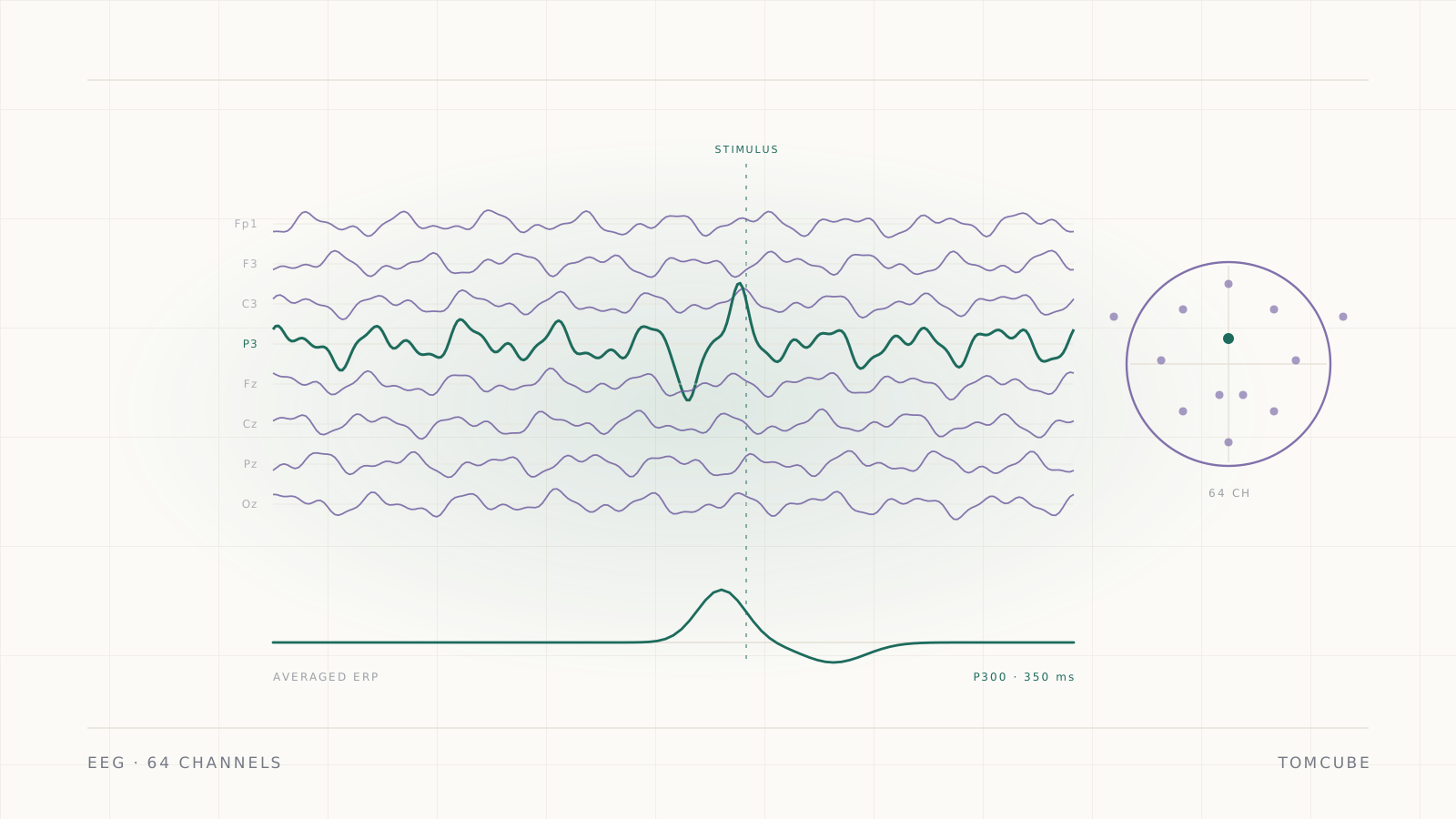
260 hours of 64-channel EEG synchronized with language stimulus events from 320 participants, supporting ERP and predictive-coding research.
- Scale
- 260 hours
- Participants
- 320 participants
- Languages
- Modern written and spoken Chinese
- Annotation
- Stimulus and response event markers, Artifact annotation, ERP component labels, Semantic and syntactic condition coding
- Formats
- EDF / BDF / JSON / CSV / MAT
- Sync
- EEG and stimulus event sync error ≤ 1 ms
- License
- Research license (ethics-approved projects only)
- Updated
- March 15, 2026
01 / Composition
Scale, key metrics and data streams
Observing the brain's response to language comprehension at millisecond scale
- 260 h
- Total duration
- 320
- Participants
- 64
- Electrodes
- ~180,000
- Trials
| Stream | Specification | Notes |
|---|---|---|
| EEG | 1,000 Hz · 64 channels | Ag/AgCl electrodes, including horizontal and vertical EOG |
| Behaviour | CSV | Reaction time, accuracy and key-press records |
| Text | UTF-8 / JSON | Stimulus materials, trial tables and condition coding |
The table lists capture parameters for a sample batch; final specifications follow the documentation delivered with the data.
02 / Dataset notes
Collection, annotation and quality control
The notes below explain how the data was collected, annotated and verified, and can be used as a basis for methodological citation and proposal assessment.
Overview
The EEG Language Processing Dataset contains 64-channel EEG recordings from 320 participants performing language comprehension tasks, totaling 260 hours and roughly 180,000 trials recorded between October 2023 and January 2026. The tasks cover five paradigms — lexical decision, semantic priming, syntactic violation, ambiguity resolution and natural discourse comprehension — with modern written and spoken Chinese as stimuli.
Participants are stratified by gender, age (18–30) and language background; all are right-handed native Chinese speakers with no history of neurological or psychiatric disorders. Each participant completes one or two sessions of 60 to 90 minutes, with breaks in between to reduce how fatigue affects the EEG.
Collection protocol
The experiment takes place in an electromagnetically shielded room with a 64-channel Ag/AgCl electrode cap sampled at 1,000 Hz; horizontal and vertical EOG are recorded simultaneously. Stimulus presentation is controlled by experiment software, which sends event markers to the acquisition system through a photoelectric sensor and parallel port, keeping stimulus and EEG aligned at millisecond precision.
Before the experiment, participants wash their hair and electrode impedance is checked; recording starts once every electrode is below 10 kΩ. The protocol is approved by the institutional ethics committee, participants sign informed consent and may withdraw at any time. Participant state and unusual events are logged after each session to support later artifact judgment.
Annotation
Annotation is event-based and covers stimulus properties, participant responses and signal quality.
| Layer | Content | Scale | Review |
|---|---|---|---|
| Events | Stimulus onset, response, feedback and segmentation markers | About 180,000 trials | Automatic validation + 10% spot-check |
| Conditions | Semantic, syntactic, frequency and predictability coding | All trials | Cross-checked against the design table |
| Artifacts | Blinks, EMG, drift and bad-channel markers | All recordings | Algorithmic detection + manual review |
| Components | N400, P600, P300 and other component windows | About 26,000 segments | Dual review, expert arbitration |
Quality & verification
The median sync error between EEG and stimulus events is 0.3 ms, with the 95th percentile at or below 1 ms. Median electrode impedance is 4.8 kΩ, the average artifact trial rate is 7.2%, and ERP component annotation agreement is κ = 0.85. Ten percent of participants in every batch go through full-process review, and bad channels and drift records are stored separately. Deliverables include the experiment programme, stimulus materials, trial tables, preprocessing parameters, component window definitions and a quality report.
Research questions
- Changes in N400 amplitude and latency elicited by semantic predictability violations.
- P600 patterns during syntactic violation and reanalysis.
- Generalization ability of cross-subject ERP decoding models.
- Whether language-model prediction error explains EEG responses.
- Differences in the time course of spoken and written language comprehension.
Access & licensing
This dataset is available only to research projects that pass ethics review; applicants must submit a study protocol, ethics approval and a data processing plan. Data is delivered as EDF, BDF, JSON, CSV and MAT, with raw signals and preprocessed data provided in separate layers, plus complete preprocessing scripts and analysis examples. Because human physiological data is involved, re-identification attempts and commercial model training are not accepted; commercial collaboration is assessed case by case. You can inspect trial-level structure through the sample data page, or ask about data use agreements on the contact page.
03 / Typical use cases
Questions this dataset can answer
The directions below are typical research and product applications; a specific analysis plan depends on the study design and statistical method.
- 01
N400 and P600 semantic–syntactic research
- 02
Syntactic violation and reanalysis
- 03
Cross-subject ERP decoding
- 04
Comparing language models with predictive coding in the brain
04 / Related datasets
Datasets that combine well
A single research question often calls for a cross-modal combination; the entries below share scenarios, speakers or annotation schemes with this dataset.
NEXT STEP
Need a different collection setting or annotation scheme?
An existing dataset can be licensed as it stands, or extended with additional speakers, scenarios and annotation layers around your study design.
Reply within one business day · NDA and data licensing supported · Dedicated academic track