SOLUTIONS · Healthcare
Healthcare and mental health
De-identified multimodal corpora and compliant delivery for consultation communication, rehabilitation assessment and psychological measurement, balancing clinical usability with privacy requirements.
Audience
Hospitals / rehabilitation / psychology practices
- Related services
- 3 modules
- Related data
- 3 directions
- De-identification and licensing review
- 2-tier
- Median annotator agreement
- 0.91
- From plan to first delivery
- 12 weeks
- Batch QA pass rate
- 98.7%
01 / Challenges
Healthcare and mental health: the data problems we see
These problems rarely come from a single stage. They sit in the gaps between design, collection, annotation and verification.
High privacy and compliance bar
Consultation audio and video contain sensitive personal information, and collection, storage and secondary use all need a traceable licensing chain.
Multiple speakers and ambient noise
Clinicians, patients and family members speak in turn while corridor noise and device alerts bleed in, complicating transcription and speaker separation.
Subjective clinical labels
Emotion, adherence and communication quality depend on professional judgment, and labels are hard to reuse without common scales and review.
Weak retention and withdrawal mechanics
Once a participant withdraws consent, data already distributed is hard to recall, leaving the institution exposed to ongoing compliance risk.
02 / Approach
How we move forward
Every project follows the same order: write the question and specification clearly, then move into collection, annotation and verification.
- 01
Ethics and de-identification first
Fix licensing granularity, de-identification rules and retention periods at the design stage, aligned with institutional ethics processes.
- 02
Lightweight on-site capture
Portable devices record consultations and interviews with minimal disruption to clinical workflow while preserving multi-stream sync.
- 03
Scales aligned to the timeline
Link clinical scales and interview phases to audio-video timecodes so subjective ratings trace back to specific segments.
- 04
Two-person review and audit
Annotators are trained together, disputed samples go to two-person review, and de-identification operations leave an audit record.
03 / Delivery
What you will receive
- Multimodal corpora with de-identification and licensing records
- Timeline annotation aligned with clinical scales
- Standardized evaluation sets for model assessment
- Compliant delivery reports supporting ethics review
The boundaries of a clinical setting
The first constraint on clinical data is not technical, it is compliance and trust. Before collection, the project has to establish who the participant is, who can withdraw, whether the data serves research or product evaluation, and how long it is retained. We work alongside institutional ethics review and split consent into the smallest selectable units, so each use gets its own authorization. Because clinical schedules are tight, the plan also states who approaches participants and when, so consent does not compete with care.
From consultation recordings to analyzable data
A consultation is a classic multi-speaker setting: clinician, patient and family members take turns, while ambient noise, forms of address and dialect mix together. We work in the order of speaker separation, verbatim transcription and time alignment, then layer on scale ratings plus emotion and paralinguistic annotation. Clinical scales are provided or reviewed by professionals at the partner institution; annotators receive common training and disputed samples go to two-person review. Where a department works in dialect or code-switches between Mandarin and a local variety, the transcription protocol records that explicitly rather than normalizing it away.
De-identification and secondary use
Names, addresses, visit numbers and identifiable imagery are de-identified before annotation begins, and de-identification operations leave an audit record. Derived features, such as transcripts and annotation layers, are covered by the same rules, because they can be re-identifying even when the audio is not. Where data is shared with a research partner, the agreement names the fields that must be removed before transfer. Delivery describes the data in two tiers, “directly usable” and “by application”, so the institution can control secondary use in later studies. Projects involving children or vulnerable groups add guardian consent and withdrawal mechanisms. Records of who consented, for which purpose, and until when travel with the corpus, so a later audit can answer the question without re-contacting families.
We do not use clinical data for unauthorized model training; every derived dataset inherits the original licensing scope. For rehabilitation and speech therapy, treatment stage, stimulus materials and response times are recorded in the same metadata, so change across sessions can be compared and later researchers can reproduce the analysis under the same conditions.
04 / Cases
Illustrative cases
The cases below come from de-identified project settings and are used only to show how we collaborate and what delivery looks like.
Outpatient consultation corpus
IllustrativeBuilt a multimodal outpatient consultation corpus for a tertiary hospital, with speaker separation, verbatim transcription and communication behavior annotation.
3 departments
Psychological interview annotation
IllustrativeCollected and annotated interview corpora for a psychology practice, linking scale scores to emotion and paralinguistic segments.
120 interviews
05 / Related capabilities
Services and data that go with it
A solution is usually delivered as a combination of services; related datasets can support evaluation, annotation or method verification directly.
Related datasets
Data catalog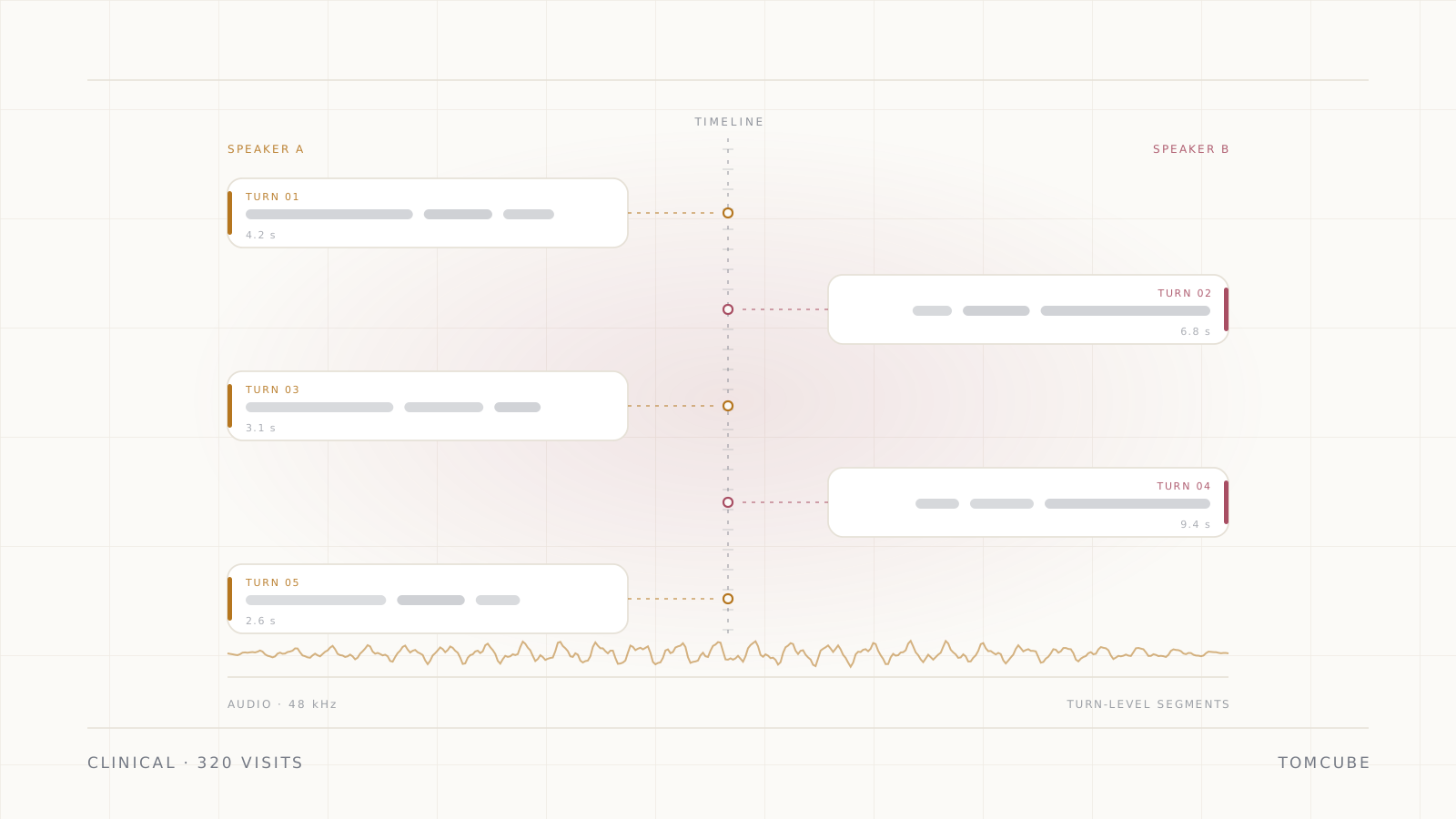
06 / FAQ
Common questions
Frequent questions about timeline, licensing and how we collaborate.
Does the data leave the hospital network?
Processing can run inside the hospital intranet or an isolated environment as the institution requires, with only de-identified results and QA reports delivered.
Can you work with the hospital ethics review process?
Yes. We provide the collection plan, consent templates and data management plan, and support the ethics committee review.
Who provides the clinical scales?
Usually professionals at the partner institution provide or review them; we handle alignment between scales and the audio-video timeline, plus annotation management.
What happens after a participant withdraws consent?
We locate and delete the corresponding data within the agreed period, then update derived data and audit records.
Start a project
Start with a data check-up
Tell us the question you need to answer, the data you already have and your time constraints. We will come back with an executable plan outline and budget range.
Reply within one business day · NDA and data licensing supported · Dedicated academic track