SYNC · CLEAN · ALIGN
Processing and alignment
Map every stream onto one time base, then run denoising, segmentation and forced alignment to produce standardized data that can be re-run and verified.
Deliverables
- Time-base alignment results and synchronization report
- Denoised, channel-corrected and converted media
- Forced alignment, segmentation and annotation intermediates
- Processing scripts, parameter lists and run logs
- Service module
- 02 / 05
- Deliverables
- 4 items
- Process stages
- 4 steps
- Quality verification
- Batch-level
01 / Service scope
What we actually do
Each capability can be switched on as a standalone module or combined into a full delivery chain.
One time base
Use the audio clock or a sync signal as the reference and build timestamp mappings across devices.
Multi-stream alignment
Align video frames, eye tracking, physiology and motion data to one timeline through event markers.
Cleaning and conversion
Channel verification, denoising, filtering and format conversion, with every parameter recorded.
Forced alignment and segmentation
Align speech to transcript, then segment by sentence, topic or event.
Re-runnable pipeline
Versioned scripts and configuration, so the same input always produces the same output.
02 / Workflow
How it moves forward
Every stage has defined outputs and checkpoints, so progress and risk surface during the work rather than at acceptance.
- 01W1
Data inventory
Inspect raw formats, time base, channels and metadata completeness.
- 02W2
Alignment design
Fix the reference clock, sync markers and error tolerance.
- 03W3
Cleaning and conversion
Run the processing chain and output standardized intermediates.
- 04W4–W5
Alignment verification and handover
Spot-check error against the sync signal, then deliver data, scripts and logs.
03 / Service notes
Who it is for, and how to begin
What we do
Processing answers one question: can these recordings be compared at all? We map every stream onto a single time base, using the audio sample clock or an external sync signal as the reference, then build timestamp mappings for video frames, eye-tracking samples, physiological channels and motion-capture frames. The output is a measured alignment result, not a report that simply declares the data synchronized.
Every alignment decision is documented with its basis. If the reference is an audio clock, we state the sample rate and the resampling path; if a marker is missing for one stream, we say which stream and what alternative was used. This matters when the data later supports a paper or a model evaluation, because a reviewer will ask how the streams were joined, not whether they looked fine on screen.
Cleaning and structuring follow. We denoise, remove DC offset and verify channels; force-align speech to transcript and segment it; correct and decimate video frames; classify fixations and map areas of interest for eye tracking; filter physiological signals and mark events. Every parameter lives in a configuration file and the whole chain can be re-run, so the same raw input always yields the same output.
Reproducibility is a design constraint, not an afterthought. We version the scripts, record the software environment, and store a checksum for the input and output of each stage. When a client already has an audit checklist, we align our standard to theirs before we run anything, rather than producing two incompatible sets of numbers.
Who it’s for
Projects that already hold raw data but cannot cross-analyze it: merging multi-batch collections, integrating data from different devices, migrating legacy corpora, and AI teams that need speech, video and sensor data on one timeline before modeling. We also support teams whose data is technically aligned but whose metadata cannot answer which participant, session or condition a file belongs to. We also take on partial pipelines: a team may only need forced alignment, or only want the eye-tracking stream mapped to the video, and that is a legitimate scope. A narrowly defined job often produces a faster, cheaper result than reprocessing a corpus that is otherwise in good shape.
How it works
- Data inventory. Inspect raw formats, time base, channels and metadata completeness.
- Alignment design. Fix the reference clock, sync markers and error tolerance.
- Cleaning and conversion. Run the processing chain and output standardized intermediates.
- Alignment verification and handover. Spot-check error against the sync signal, then deliver data, scripts and logs.
Delivery and verification
Deliverables include the alignment result and sync report, denoised and channel-corrected media, forced alignment and segmentation files, and the processing scripts with parameter lists. Alignment error is reported in milliseconds along with the measurement method; segments that cannot be aligned or are missing a signal are flagged separately rather than dropped silently. We keep a checksum of the data before and after processing for reproduction and audit. Where processing reveals a raw-data problem, such as a dropped channel or a clock that drifted mid-session, the finding is reported as an exception with the affected time range, and the batch is not silently patched.
How to get started
Send a format sample and an approximate volume of raw data. We run a feasibility assessment first and return an alignment plan, timeline and risk list. If the raw data has no sync markers, we assess how much can be recovered before deciding whether a supplementary collection is needed.
04 / Deliverables
What you receive
Deliverables are organized to be citable and reproducible: naming, metadata and verification records are complete, ready for analysis or archiving.
Deliverable 01
Time-base alignment results and synchronization report
Deliverable 02
Denoised, channel-corrected and converted media
Deliverable 03
Forced alignment, segmentation and annotation intermediates
Deliverable 04
Processing scripts, parameter lists and run logs
05 / FAQ
Common questions
If your question is not covered, contact us directly.
Can you align raw data with no sync markers?
We first assess how much is recoverable. Shared events such as a clap, a flash or a speech onset can support event-based alignment, with accuracy depending on how clear the event is. Anything unrecoverable is flagged explicitly; we do not pretend it is aligned.
Does processing modify the raw data?
No. Raw data is kept read-only, all results are written to new directories, and script versions and parameters are logged.
Which formats do you support?
Audio in WAV or FLAC, video in MP4 or MKV, annotations in TextGrid, ELAN or JSON, and eye-tracking and physiological data converted from native formats to CSV or Parquet.
How long does processing take?
Depending on volume and stream count, a typical batch runs 1–3 weeks. Multi-device integration or complex alignment is scoped separately.
06 / Related datasets
Datasets delivered with this service
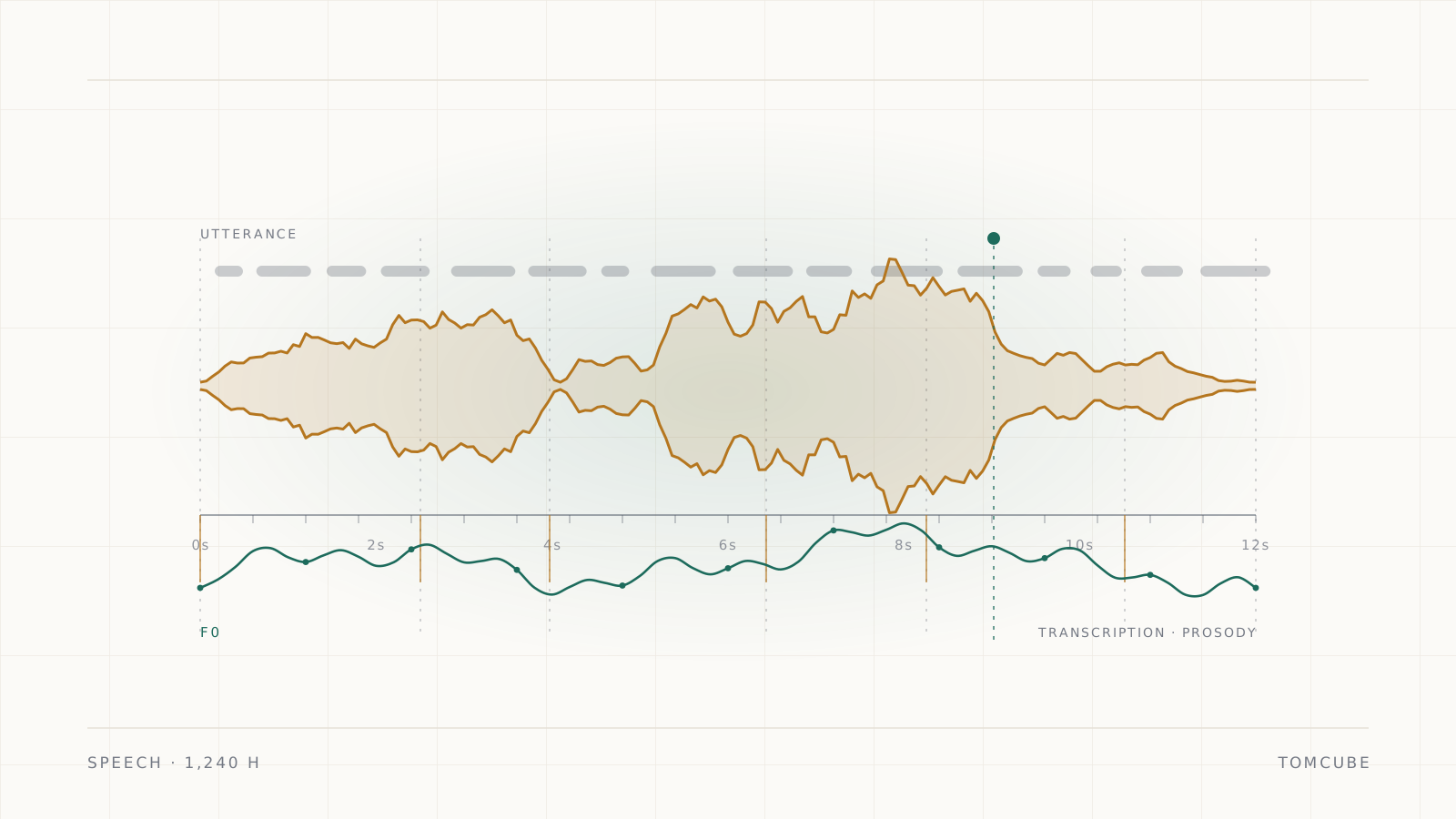
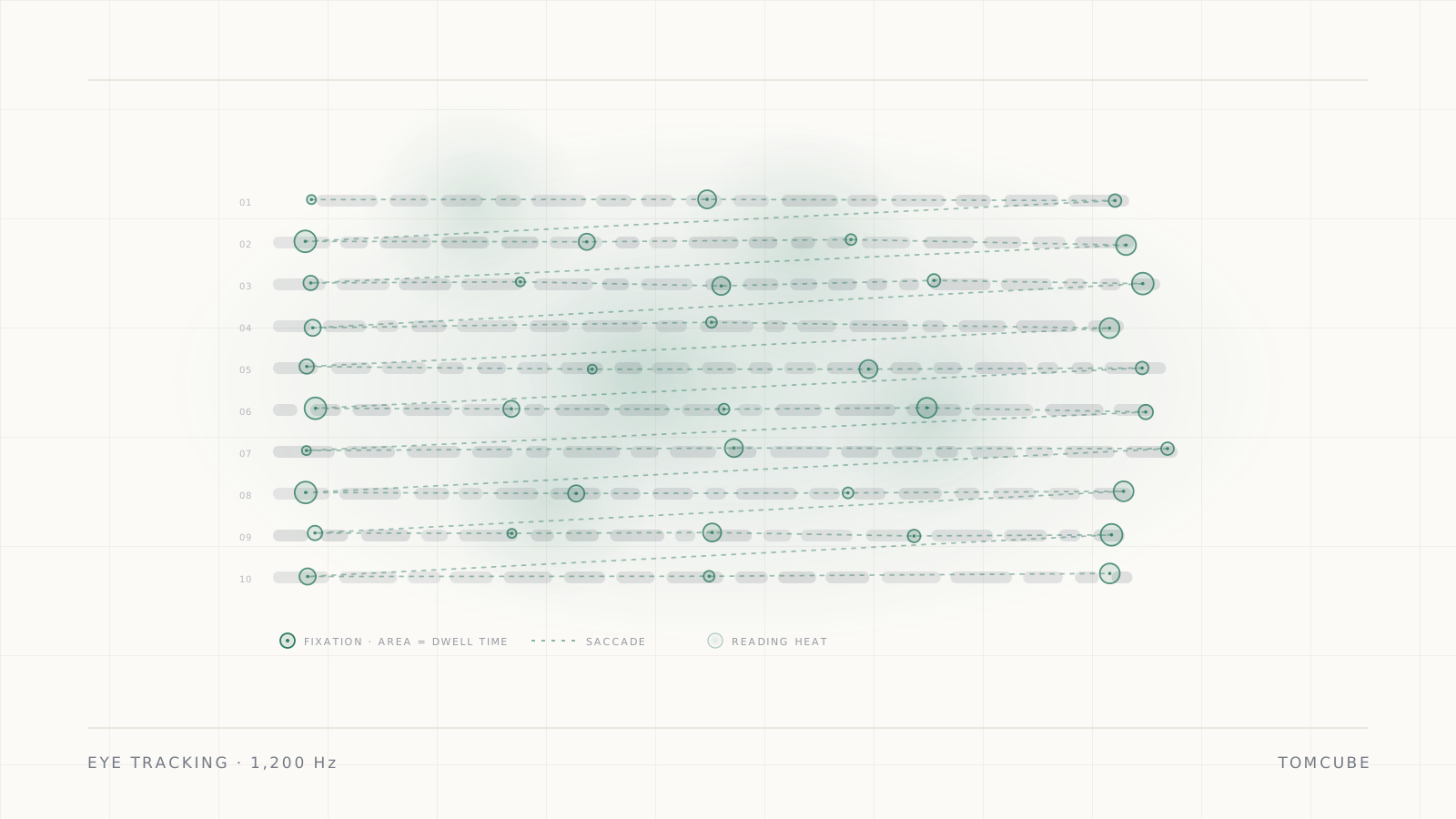
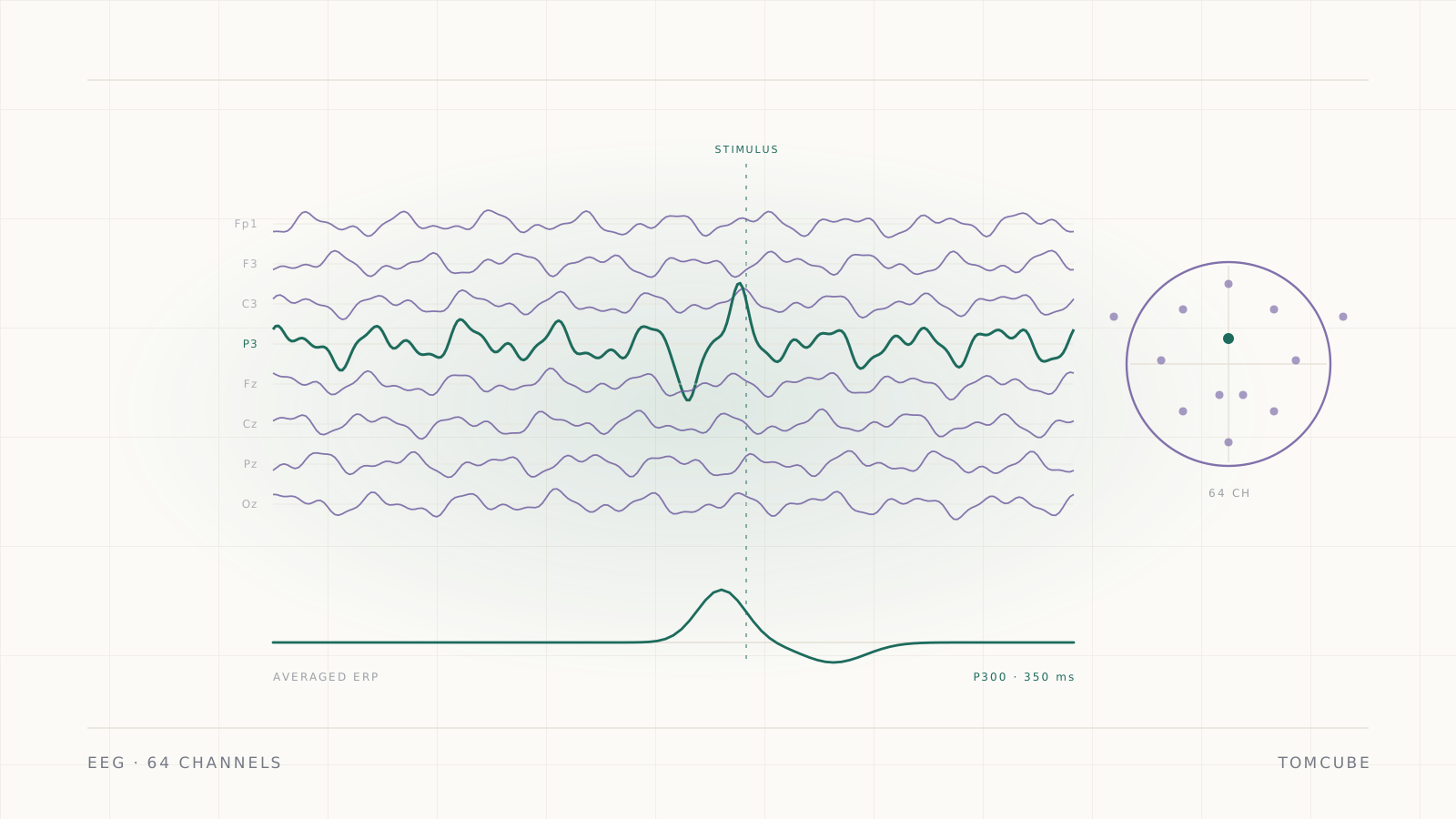
Public entries in the data catalog, useful as references for specifications, annotation and delivery formats.
Start a project
Move existing data onto one time base
Send a format sample and an approximate volume of raw data. We run a feasibility assessment first, then define the alignment plan and processing scope.
Reply within one business day · NDA and data licensing supported · Dedicated academic track