DATASET 04 · Developmental linguistics
Children's Language Development Longitudinal Corpus
540 hours of natural interaction from 260 children tracked over 36 months, delivered with CHAT transcripts and developmental measures.
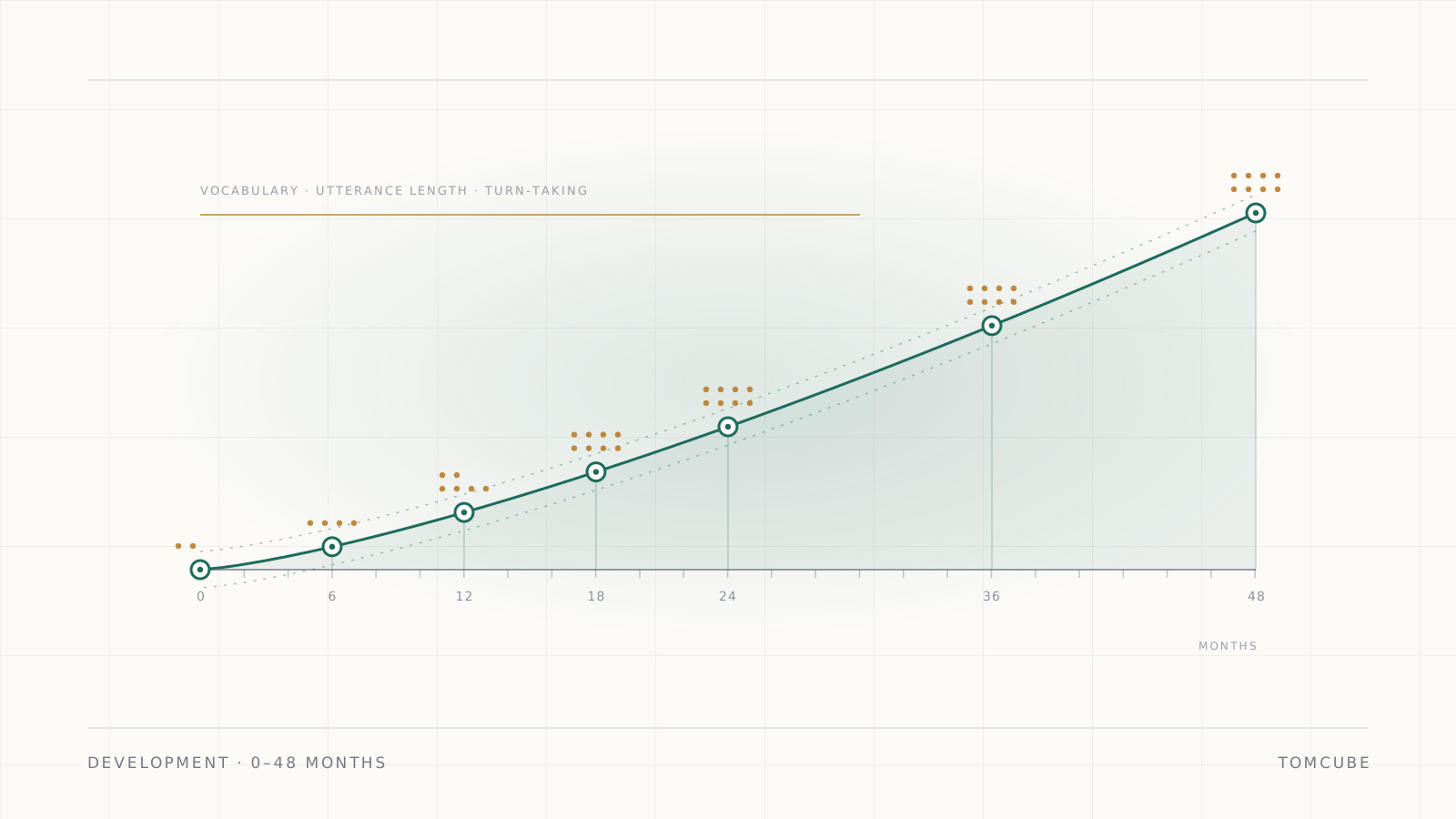
- Scale
- 540 hours
- Participants
- 260 children
- Languages
- Mandarin (children's spontaneous speech)
- Annotation
- CHAT-format transcription, Part-of-speech and syntactic annotation, Phonological error annotation, Parent-child interaction coding
- Formats
- WAV / MP4 / CHAT / JSON
- Sync
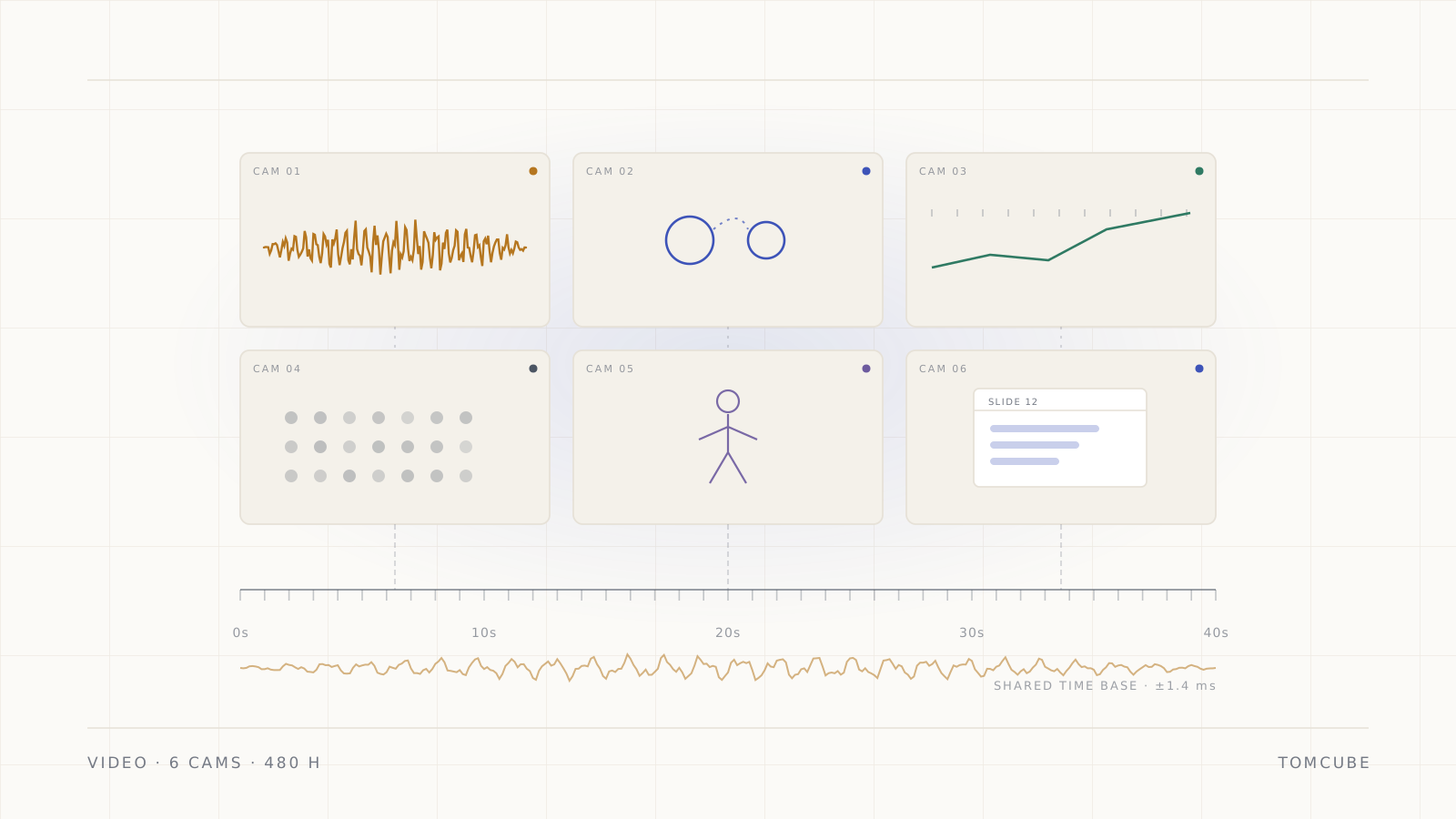
- Audio-video sync error ≤ 2 ms
- License
- Research license (ethics-approved projects only)
- Updated
- June 30, 2026
01 / Composition
Scale, key metrics and data streams
Recording the emergence and change of language along a developmental timeline
- 540 h
- Total duration
- 260
- Children
- 36 months
- Tracking period
- 214
- Households
| Stream | Specification | Notes |
|---|---|---|
| Audio | 48 kHz / 24-bit | Lavalier microphones, with child and caregiver on separate tracks |
| Video | 1920 × 1080 · 30 fps | Single fixed camera in the natural home setting |
| Text | CHAT / UTF-8 | CHAT transcript with part-of-speech and syntax layers |
The table lists capture parameters for a sample batch; final specifications follow the documentation delivered with the data.
02 / Dataset notes
Collection, annotation and quality control
The notes below explain how the data was collected, annotated and verified, and can be used as a basis for methodological citation and proposal assessment.
Overview
The Children’s Language Development Longitudinal Corpus follows 260 children from 214 households for 36 months, yielding 540 hours of natural interaction recorded between February 2023 and February 2026. Children enrolled between 18 and 42 months of age, and each household completed a recording every three months, roughly 45 minutes per visit, covering three activity types: free play, shared picture-book reading and mealtime conversation.
The corpus is stratified by age, gender, home language environment (monolingual or bilingual) and caregiver education. Twelve children withdrew during the study, and both the reason and the timing of each withdrawal are recorded in the metadata so attrition bias can be analyzed.
Collection protocol
Collection happens mainly in the natural home setting, avoiding the influence a laboratory environment can have on children’s expression. Child and caregiver each wear a lavalier microphone and are recorded on separate tracks at 48 kHz / 24-bit. A single 1920 × 1080 · 30 fps camera covers the play and reading areas and is not moved during recording, to avoid distraction.
A research assistant sets up the equipment and checks audio calibration before recording, then leaves; a parent operates a simple start and stop flow. Every household signs an informed consent form, and recording stops immediately if a child shows distress. Segments that reveal the identity of household members are masked and voice-altered before ingest.
Annotation
Transcription follows the CHAT convention, with phonological and interaction layers added on top.
| Layer | Content | Scale | Review |
|---|---|---|---|
| Transcript | CHAT sentence-level transcription, pronunciation variants, repetitions and self-repairs | About 600,000 sentences | 25% double-blind review |
| Phonology | Segmental errors, syllable structure, tone realization | About 180,000 error instances | Dual review by phoneticians |
| Syntax | Part of speech, sentence length, clause depth | Full corpus | Automatic annotation + 20% manual correction |
| Interaction | Joint attention, turn-taking, expansion and recast | 10 behaviour classes | Dual annotation of key segments |
Quality & verification
The median audio-video sync error is 1.5 ms, with the 95th percentile at or below 2 ms. CHAT transcription agreement is κ = 0.90, phonological error agreement is κ = 0.84 and parent-child interaction coding agreement is κ = 0.86. Fifteen percent of each batch is double-blind reviewed, and 5% of that is finally reviewed by developmental linguistics researchers. Deliverables include age-norm tables, transcription conventions, annotation manuals and a longitudinal matching guide.
Research questions
- The order in which Mandarin-speaking children acquire tones and consonants.
- Longitudinal growth curves for vocabulary size and syntactic complexity.
- How expansion and recasting during shared reading affect language development.
- Early phonological and interactional markers of language delay.
- How a bilingual environment shapes children’s code-switching patterns.
Access & licensing
This dataset is available only to research projects that pass ethics review; applicants must submit a study protocol, ethics approval and child data protection measures. Data is delivered as WAV, MP4, CHAT and JSON, filtered by age band and activity type, with longitudinal matching IDs irreversibly mapped. Commercial use is assessed case by case, and source video is generally not provided. You can inspect the CHAT field structure through the sample data page, or ask about the application process on the contact page.
03 / Typical use cases
Questions this dataset can answer
The directions below are typical research and product applications; a specific analysis plan depends on the study design and statistical method.
- 01
Child speech acquisition order research
- 02
Vocabulary growth and syntactic complexity analysis
- 03
Early markers of language delay
- 04
Parent-child interaction quality assessment
04 / Related datasets
Datasets that combine well
A single research question often calls for a cross-modal combination; the entries below share scenarios, speakers or annotation schemes with this dataset.
NEXT STEP
Need a different collection setting or annotation scheme?
An existing dataset can be licensed as it stands, or extended with additional speakers, scenarios and annotation layers around your study design.
Reply within one business day · NDA and data licensing supported · Dedicated academic track