DATASET 07 · Dialectology
Chinese Dialect Speech Archive
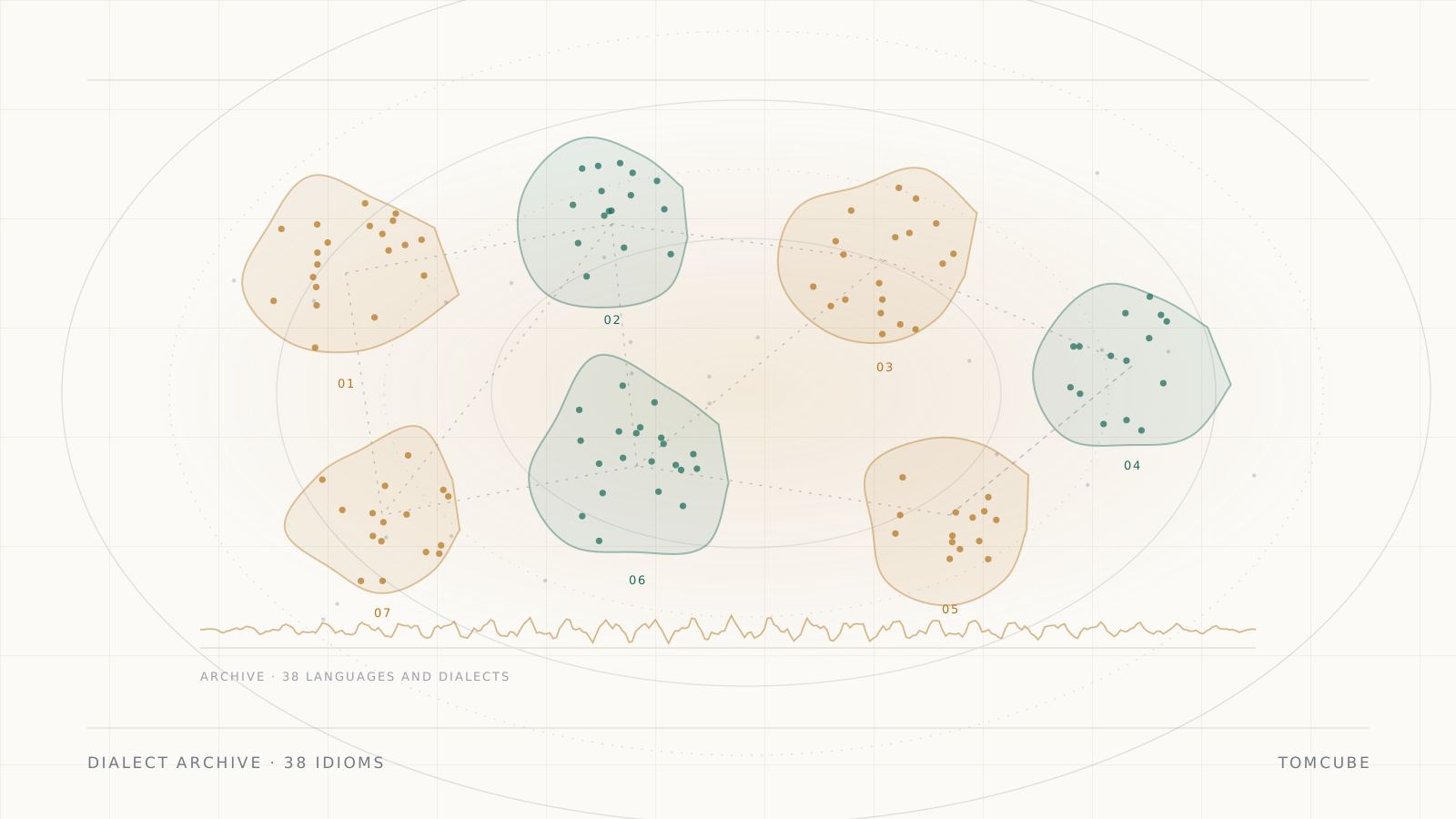
A 2,150-hour speech archive spanning seven major dialect areas and 24 survey sites, with IPA transcription and speaker metadata.
- Scale
- 2,150 hours
- Participants
- 1,860 speakers
- Languages
- Seven major Chinese dialect areas · 24 survey sites
- Annotation
- IPA transcription, Tone annotation, Lexical and grammatical questionnaire, Speaker metadata
- Formats
- WAV / FLAC / TextGrid / JSON
- Sync
- Audio-video sync error ≤ 2 ms
- License
- Research license (tiered access)
- Updated
- April 10, 2026
01 / Composition
Scale, key metrics and data streams
Preserving a traceable acoustic record of voices that are disappearing
- 2,150 h
- Total duration
- 24
- Survey sites
- 1,860
- Speakers
- 3,200
- Lexical items
| Stream | Specification | Notes |
|---|---|---|
| Audio | 48 kHz / 24-bit | Headset microphone, recorded in a quiet room |
| Video | 1920 × 1080 · 25 fps | Lip and face recording for articulation research |
| Text | UTF-8 / JSON | IPA, character correspondences and questionnaire coding |
The table lists capture parameters for a sample batch; final specifications follow the documentation delivered with the data.
02 / Dataset notes
Collection, annotation and quality control
The notes below explain how the data was collected, annotated and verified, and can be used as a basis for methodological citation and proposal assessment.
Overview
The Chinese Dialect Speech Archive covers the seven major dialect areas — Mandarin, Wu, Gan, Xiang, Min, Yue and Hakka — across 24 survey sites and 1,860 speakers, totaling 2,150 hours recorded between September 2022 and January 2026. Each site includes 60 to 90 speakers, balanced by age band and gender, with priority given to residents who still speak the local dialect fluently.
The corpus has three parts: a core 3,200-item word list, a grammar questionnaire and natural narration. The word list supports comparison across dialects, while natural narration covers local stories, descriptions of customs and personal experience in segments of 3 to 15 minutes, providing continuous speech for acoustic and prosodic research.
Collection protocol
Recording takes place in a quiet room with a headset microphone at 48 kHz / 24-bit, while a 1920 × 1080 · 25 fps camera records lip movement and facial expression. Each site is led by an investigator familiar with the local dialect: the word list and questionnaire come first, followed by natural narration. Investigators follow a unified elicitation script so that question phrasing does not influence lexical choice.
Speakers must have been born locally or have lived in the area continuously for more than 20 years. They sign informed consent and complete a language background questionnaire recording home languages, time spent away and frequency of Mandarin use. All identifying information is replaced with codes at ingest, and the original contact list is held by a designated custodian and never delivered with the data.
Annotation
Annotation is built on the International Phonetic Alphabet and combines phonological, acoustic and lexical information.
| Layer | Content | Scale | Review |
|---|---|---|---|
| Phonology | Broad IPA transcription, initials, finals and tones | 3,200 word-list items | Dual transcription, third-party arbitration |
| Tone | Pitch values, tone categories, tone sandhi | Full word list | Acoustic measurement + manual review |
| Lexicon | Word meaning, morphemes, etymological character identification | 3,200 items | Final review by dialectology experts |
| Metadata | Speaker background, collection site, equipment | Full corpus | Dual check at ingest |
Quality & verification
The median audio-video sync error is 1.3 ms, with the 95th percentile at or below 2 ms. Recording signal-to-noise ratio is at least 45 dB, IPA transcription agreement is κ = 0.86, and tone pitch measurements agree with perceptual identification 93.5% of the time. Ten percent of each batch is reviewed by dialectology experts, and difficult etymological characters and tone sandhi cases are recorded with separate dispute notes. Deliverables include the survey manual, word list, speaker metadata table and transcription conventions.
Research questions
- Typological comparison of tone systems across the seven major dialect areas.
- How fully tone sandhi rules surface in natural speech.
- The speed at which dialect vocabulary is contacted and replaced by Mandarin.
- How age and gender affect phonetic variation.
- Acoustic archiving and reconstruction of endangered dialect features.
Access & licensing
This dataset uses tiered access: the word list and metadata are open to research users, while natural narration and video require a separate application and ethics review. Commercial use does not include source video; only acoustic features and statistical results can be licensed. Data is delivered as WAV, FLAC, TextGrid and JSON. You can inspect word-list and annotation examples through the sample data page, or describe your research use and required sites on the contact page.
03 / Typical use cases
Questions this dataset can answer
The directions below are typical research and product applications; a specific analysis plan depends on the study design and statistical method.
- 01
Comparative study of dialect tone systems
- 02
Archiving and revitalization of endangered dialects
- 03
Data supplementation for dialect speech recognition
- 04
Language contact and variation research
04 / Related datasets
Datasets that combine well
A single research question often calls for a cross-modal combination; the entries below share scenarios, speakers or annotation schemes with this dataset.
NEXT STEP
Need a different collection setting or annotation scheme?
An existing dataset can be licensed as it stands, or extended with additional speakers, scenarios and annotation layers around your study design.
Reply within one business day · NDA and data licensing supported · Dedicated academic track